Property Use Cases
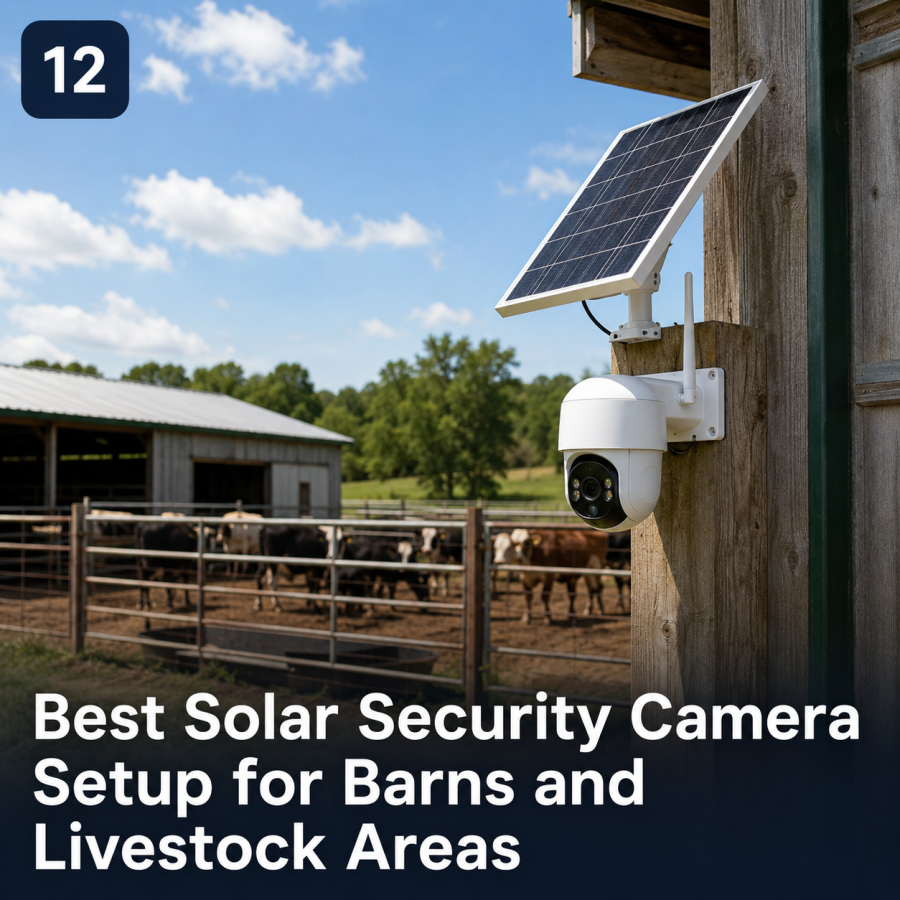
Best Solar Security Camera Setup for Barns and Livestock Areas
Short answer: start a barn camera plan with the places animals, people, and vehicles naturally pass: the barn entrance, gates, pens, feed or equipment areas, and access roads. Then choose WiFi or 4G based on the signal that actually reaches each point, and place the solar panel where it receives reliable sunlight rather than simply wherever the camera has the best view.
A Practical 3-Camera Barn Layout
| Camera Position | Main Purpose | Placement Goal |
|---|---|---|
| Barn entrance | People, vehicles, deliveries | Capture the approach path and doorway |
| Livestock pen or calving area | Animal monitoring | Use a wide overview without placing the camera where animals can hit it |
| Feed, fuel, or equipment zone | Supplies and equipment | Watch a predictable access point rather than an empty field |
1. Start With the Main Barn Entrance
The entrance is often the highest-value first camera because workers, visitors, vehicles, and animals pass through a predictable area. Aim for a useful view of both the doorway and the approach path instead of mounting so high that only the tops of heads or vehicles are visible.
2. Cover Pens and Livestock Areas With a Wider View
For pens, feeding areas, or calving zones, an overview angle is usually more useful than a tight close-up. Avoid fence posts, roof supports, gates, or hanging equipment blocking the main activity area.
If a PTZ camera is used, remember that the lens still looks in only one direction at a time. Use fixed coverage for critical choke points when you cannot afford a blind direction.
3. Protect Equipment, Feed, Fuel, and Supplies
Equipment and supply areas are often easier to monitor when the camera watches the entry path into the zone rather than trying to cover an entire open yard. Focus on gates, doors, fuel access, tool storage, and vehicle approaches.
4. Keep the Solar Panel Out of Barn Shade
A camera can have a perfect view under a roof edge while its solar panel receives poor light. Barns create large moving shadows throughout the day, so treat the camera angle and panel position as two separate installation decisions whenever the hardware allows it.
5. Choose WiFi or 4G Based on the Barn's Real Signal
| Condition | Better Starting Point |
|---|---|
| Strong WiFi reaches the barn | Solar WiFi camera |
| Barn is beyond WiFi but has cellular coverage | 4G solar camera |
| No WiFi and no usable cellular coverage | Add network infrastructure before expecting reliable remote access |
6. Reduce False Alerts Around Animals
Livestock, wildlife, insects, moving vegetation, and activity around feed areas can create many events. Start with camera angle and detection zone, then adjust sensitivity and person/AI filters if your model supports them.
7. Plan for Night Monitoring
Barns often have uneven lighting: bright fixtures in one area and deep darkness in another. Before final mounting, review the night view and make sure lights, reflective metal, nearby walls, or spider webs do not dominate the image. Color night vision can be useful when enough light is available; infrared can be useful where visible light is limited.
8. Mount Where Animals Cannot Easily Damage the Camera
Avoid positions where cattle, horses, or equipment can directly contact the camera, cable, or solar panel. The installation should be secure, stable, and clear of gates or moving machinery.
Where We Would Place Cameras First
- Main property or barn entrance
- Equipment/fuel/feed storage
- Livestock pen or high-activity animal area
- Remote gate
- Secondary access route
Monitoring a Farm or Ranch Without Reliable WiFi?
Frequently Asked Questions
Where should I place the first camera around a barn?
The main entrance is usually a strong starting point because it captures a predictable path for people, vehicles, and animals.
Can a solar camera work under a barn roof?
The camera can sometimes be sheltered, but the solar panel still needs adequate sunlight. If possible, position the panel separately in a sunnier location.
Do I need WiFi at the barn?
Not if you use a compatible 4G camera and the barn has usable cellular coverage.
How can I reduce livestock motion alerts?
Adjust camera angle, detection zones, sensitivity, and available AI/person filters so the system focuses on the activity that matters.
Is one PTZ camera enough for a barn?
It can cover a broad area, but a PTZ lens still faces one direction at a time. Critical entrances may benefit from dedicated fixed coverage.
137users like this.